What is repugnance and why does it matter?
On Al Roth's new book and morality in economics
For a deeper dive on the subjects addressed here, please check out my new book, In Good Faith: How the Nature of Belief Shapes the Fate of Societies, which is now out and available for purchase!
Back in 2018, I wrote a series of columns for The Economist calling out different problems with economics (the way of seeing the world, not the profession, though there are plenty of problems there, too). One of these columns focused on the fact that economists just don’t take questions of values or morals very seriously. It’s weird when you think about it: that a field dedicated to human behavior would mostly disregard an essential component of our social structures.
Well, in response to the column I got email. People thought I was unfair to economics and failed to fully appreciate the work that had been done on questions of morality. I had a curt exchange with Al Roth — a giant in the field and a co-winner, in 2012, of the economics Nobel — who was clearly exasperated by the suggestion that economists should develop ways of evaluating how moral beliefs matter to the operation of society. I guess people find it annoying when a lowly journalist questions one of the fundamental assumptions of the work that won them a Nobel.
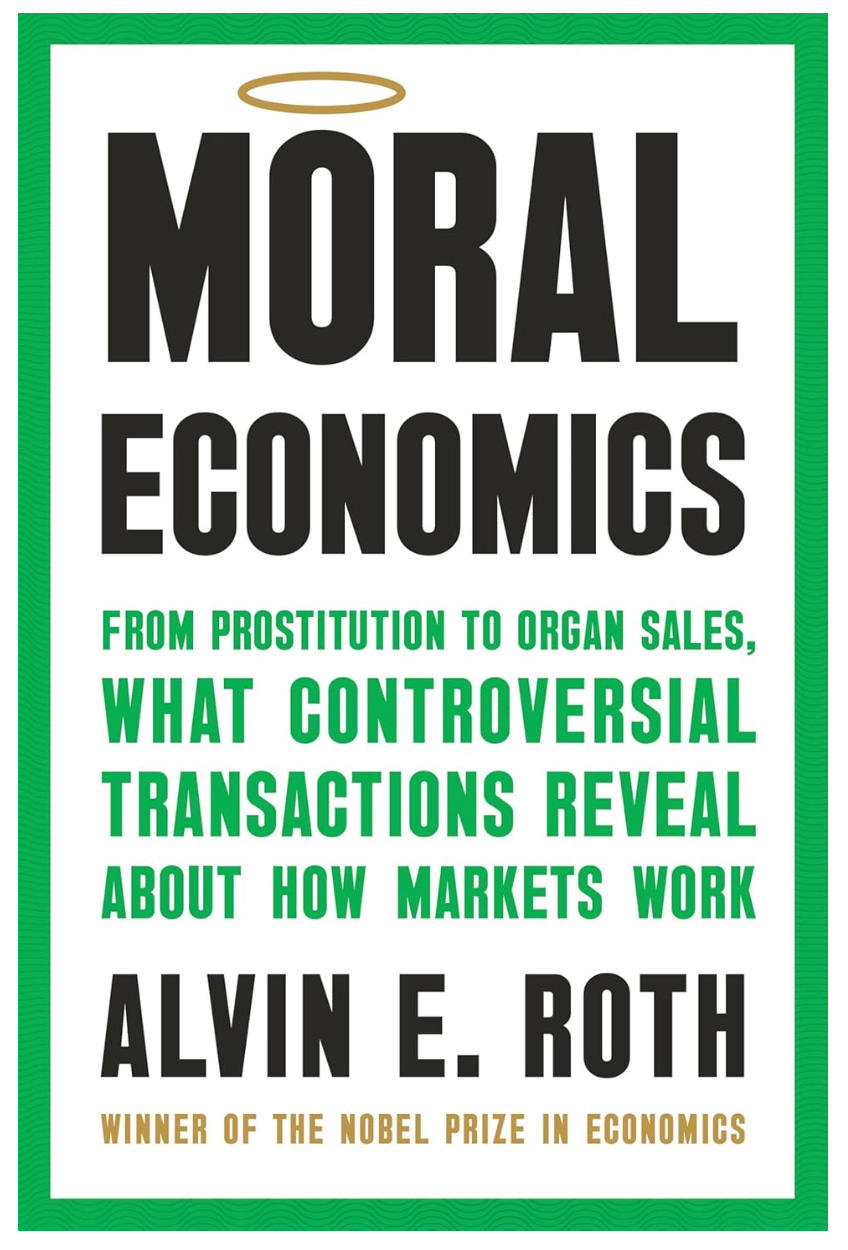
Anyway! Flash forward eight years, and there are two new books out tackling precisely this thorny matter: mine and Al Roth’s. Roth’s Moral Economics: From Prostitution to Organ Sales, What Controversial Transactions Reveal About How Markets Work was published just this month. It’s worth reading.
To back up for a moment, Roth has done fascinating work in the sub-field of market design, and there can’t have been many economists in history who have done more to save actual human lives. What’s market design? There are many kinds of markets which just emerge more or less naturally when background conditions are conducive. Some people have things they want to sell, others want to buy those things, and when those people find each other informal structures quickly come together to support mutually beneficial exchange. But there are also kinds of interactions that are market-like in some respects, but which also have features that make it hard for market activity to emerge or which generate market outcomes that no one really likes. In some cases, these market-like situations create an opportunity for a skilled economist to play engineer: to design market structures that help realize benefits of market exchange that wouldn’t otherwise be realizable.
You can imagine a matching market, for example, in which both sides of an exchange are trying to match with a preferred opposite: like a pool of competitive schools trying to attract the students they want as those students try to win acceptance at the schools they prefer. In these situations, it’s easy to end up with sub-optimal outcomes — with student-school pairs in which both parties would prefer to be matched with someone else — because people accept good offers right away for fear of losing out on any offer if they wait for their first choice, for example. This situation can be improved upon: by getting students to provide ordered preferences and using a clearinghouse, say.
Roth’s most notable market-design work addresses the challenge of finding kidneys for transplantation into sick patients. A person can’t live without a working kidney, but most people have two healthy kidneys. So while many transplantable kidneys come from deceased donors, there are also people who choose to donate one of their working kidneys to someone in need: typically but not always a loved one. This is incredibly selfless, virtuous behavior on the part of the donor.
Circumstances can sometimes work against this selflessness, however, including various rules around kidney donation but also the fact that not every willing donor has a kidney that is compatible with the intended recipient (due to blood-type or other differences). This problem can be overcome, however, through some clever market design. Groups of potential recipients and donors can be put together in such a way that everyone gets the match they need. A person who wishes to donate to a dear friend but can’t because of an incompatibility instead donates to another recipient-donor pair in a similar situation. The donor in that pair in turn provides their kidney to yet another pair, and so on down a chain until everyone has a match. In these sorts of markets, a totally altruistic, undirected donor who is simply providing a kidney for an anonymous other out of the goodness of their heart can unlock a whole vast chain of cascading donations, saving dozens of lives.
This is where Roth detours into more morally complicated territory. Because of the way that these markets work, it would be very valuable to find ways to induce more people to make undirected donations. The most straightforward way to achieve this would be to offer payments to people in exchange for undirected donations. But generally speaking it is illegal to sell human organs. So, how should an economist think about this problem?
Roth has engaged in significant study of situations like these, which he calls repugnant markets. A repugnant market is a situation in which two parties wish to engage in a mutually beneficial exchange, but other parties find such exchanges to be morally troublesome (even if they are not directly affected by them in any way), with the result being that these exchanges are often tightly controlled or banned. Many “vice” categories fall into repugnant territory (drugs, gambling, sex work), but so do things like market exchange of blood, plasma, and organs, or less-markety kinds of social behavior (like gay marriage).
Roth, to his credit, reckons that economists need to understand these situations better, because repugnance clearly shapes which markets can and cannot operate. A better understanding might allow economists to overcome the constraints imposed by repugnance in some cases, realizing large gains from trade. In the kidney case those gains include money in the pocket of donors, and also lots of saved lives. In his new book, Roth walks readers through many of the different kinds of repugnant markets that he has studied, in order to build the case that using well-structured markets to manage contested exchange is often a better approach than either fully banning or legalizing those activities.
There are lots of ways to argue about this, and lots of people have argued with Roth. Some of the arguments against the Roth approach are more philosophical in nature: that it is an affront to human dignity to devalue a body part or a person by exchanging it in a market setting like a pair of shoes or a loaf of bread. Others are more practical: can we really be sure that such markets will not be exploitative of the vulnerable? Well and many are pure repugnance: we can’t let such transactions take place because they’re wrong, because god says so or whatever.
It’s good to have those arguments, but my beef with Roth was of a different nature: are we sure we understand what repugnance does within society well enough to draw conclusions about the wisdom of subverting it? I might look around the first floor of my house and think how cool it would be to have the space completely open. But even if I see no practical reason why removing a bunch of walls should be a problem, spending some time evaluating that question is nonetheless a pretty good idea, right? No, in so many words, was the answer I got from Roth, and that no was one of the nudges that set In Good Faith in motion.
For many economists (and really, for many thinking people) it is hard to even begin to conceptualize how something like tradition-rooted distaste for voluntary action by others, which has seemingly no effect on others and in many cases goes entirely unobserved, could be doing much or any constructive work across society. For one thing, the distaste often comes packaged with broader belief systems rooted in the supernatural that seem entirely antithetical to reason and science. For another, many of us have watched this kind of distaste frustrate efforts to improve society that are clearly good: including everything from the expansion of basic human rights to all people to the advancement of science. And then third, there is simply no room for such distaste to do much work, good or bad, within the primary mode of social-science analysis, which sees the social world as made up of individuals, pursuing their own ends, within institutional structures that tend to be purposefully built to solve specific problems.
I didn’t find it easy to see past all this either, but I eventually got there, and the answer I share in the book points us toward a very different way of seeing society. Roth acknowledges that shared belief structures the social world. This is what bothers him about repugnance: that it constrains what society can be and shapes the material outcomes that are open to us. The funny thing is, that’s like 98% of the way to my model of society. All you really have to do from there is take belief seriously as a social force and try to understand how it works.
In my book, I present belief as a piece of behaviorally relevant meaning shared across a group of people. The meaning provides guidance as to how individuals are supposed to behave. When the members of the group of believers behave according to this guidance, the result is an “institution”, which interacts both with other individuals and other institutions. (An institution might be many things: the legal profession, Methodism, Bills fandom, democracy, etc.)
To be part of an institution is to incorporate that association into your identity. Identifying with the institution creates an intrinsic motivation to behave in the appropriate way (which is what allows these institutions to work, despite the fact that it is individually costly to participate in the institution while many of the benefits it generates are diffuse). There is a mapping, in other words, between a piece of shared meaning, the identities of the individuals that share it, and the institutions they make manifest. Then finally, what an institution does within the broader institutional ecosystem depends upon the nature of the belief shared among its members; different sorts of ideas lead to different institutional behaviors which in turn have different effects on the cooperative and productive potential of society. Oh, and these institutions and the beliefs that support them are subject to evolutionary dynamics.
Seeing the world this way leads to lots of interesting places, and the book uses this perspective to reinterpret human history, to analyze current social crises, and to imagine what the future might be like. Please buy it and read it and tell others about it, yadda yadda yadda.
Where my disagreement with Roth is concerned, I think there are a few key takeaways. One is that it’s actually very productive to interrogate the nature of repugnance, and not just recognize it as an obstacle to market activity, because doing so points us toward a powerful new way of doing social science. Another is that the perspective I present can help us better understand when repugnance is load-bearing in some important way and when it isn’t, and it can help us be more successful in overcoming obstacles to progress in the latter case. If religious groups with good moral commitments — to equality in god’s eyes and the reduction of suffering, say — share a repugnance which sometimes works counter to those commitments, then we’re probably better off helping those groups to see the inconsistency between the repugnance and their self-conceptions than we are calculating and gesturing at potential gains from trade. To be fair to Roth, this is something he has explained to other economists: that a cost-benefit analysis is often an unproductive response to repugnance.
Finally, there may be situations today in which expanding market activity or relying more on monetary incentives delivers better outcomes, but in a world of increasing material prosperity we should assume that these forces will (and should!) play ever smaller social roles. What actions society engages in will be ever less a matter of overcoming scarcity and ever more a matter of judging what is best to do. Or as I put it in the book:
[W]e have to take account of our moral potential and the way in which legitimizing organ sales might influence it. Because it is absolutely legitimate to believe that there are possible futures in which we are both far more generous and far more technologically capable as a society, and in which we are thus able to save many more lives — including those of people with kidney diseases — without creating markets for human organs. Indeed, it could be the case that extending the benefits of technology in the future is mostly a matter of recognizing the fundamental worth of every person, including those who might lack the financial capacity to obtain some lifesaving treatments. We are a moral work in progress, and that has to be a component of our reasoning about the good.
Further reading: In Good Faith: How the Nature of Belief Shapes the Fate of Societies
ood discussion and the title had me thinking of a different kind of repugnance. Repugnant culture other is a term I associate mostly the rationalist center right, perhaps polarization is the less weighted over all term (or that's my comfortable in my left of center community speaking).
Extrapolating on In Good Faith, I'd argue that the Modern Faith of atomistic economic utility maximizers has in recent years been losing its hegemonic status but has no successor. Much of the areas of repugnance you and Al Roth are exploring could be traced to what I'd argue is it's U.S. predecessor, a fairly WASPy ecumenical Protestantism intertwined with civic nationalism.
I found Jonathan Rauch's Cross Purposes an interesting, if not as theoretically grounded, attempt to at what a possible U.S. hegemonic successor might look like by putting emphasis on pluralism and reasonable accomodation (although Rauch's oddly strident critique of the Permanent Problem wasn't the best illustration of said pluralism). The approach appeals to me because I think pulling out of a complexity collapse vicious cycle, let alone building something better, will requrie figuring out a variety of communities of belief that are mutually repugnant, can live and evolve together. That doesn't mean we can escape politics and just admire the Declaration of Independence together or the like, but figuring out how pluralism must evolve and how to shape the competition of our more polarized blocks seems like a challenge for political science.
In my own field, I probably need to read a lot more of the internationl relations constructivism literture ( https://en.wikipedia.org/wiki/Constructivism_(international_relations) ) which anticipates many of the arguments you make.