Consider the phone
On meeting today's social crises and preparing for those to come
For a deeper dive on the subjects addressed here, please check out my new book, In Good Faith: How the Nature of Belief Shapes the Fate of Societies, which is now out and available for purchase!
Consider a device of incredible power. It is, first, a universal communicator; with it, you may instantly send messages of text, audio, or video to anyone anywhere in the world, with instant translation across all of the world’s major languages. The device, furthermore, provides instant access to very nearly all of human knowledge, of both a theoretical and practical nature; you may use it to plumb the frontiers of science and then to guide you through a bit of home plumbing. Similarly, you may use the device to call up nearly any piece of art you choose; you may peruse the works of Raphael, have a quick skim through Rumi, then listen to the complete discography of REM. It is a universal map; the device can guide you from any place in the world to any other place, show you a bird’s eye view of Rapa Nui or Osama bin Laden’s Abbottabad compound, and tell you precisely which star you’re looking at. It is also a one-stop point of engagement with the global economy; in just a few minutes you can book a point-to-point trip halfway around the world, liquidate a million-dollar portfolio, and send a ton of manure to your former place of business. Somehow, all of this merely scratches the surface of what can be accomplished with this miracle device.
This device exists, of course. Nearly everyone has one. It has proven to be one of the most destructive technologies of the past century. How can this be, and what can we learn from this experience?
Assessing costs
That the smartphone is, on net, a highly destructive device is not widely accepted, exactly. Many people believe it to be a significant contributor to a host of social ills, but many others are less concerned, and the vast majority of people would fight you physically if you tried to take it away from them.
There have been plenty of efforts to quantify the harm done by phones. The best-known case against smartphone use, especially among young people, is that mounted by Jonathan Haidt in his book The Anxious Generation and related work. Haidt argues that phones have dramatically changed the experience of growing up, and this change shows up clearly in data on various measures of well-being. If you approach the book in a generally sympathetic way, the case seems unassailable. Many critics note, however, that most of the evidence presented looks like this:
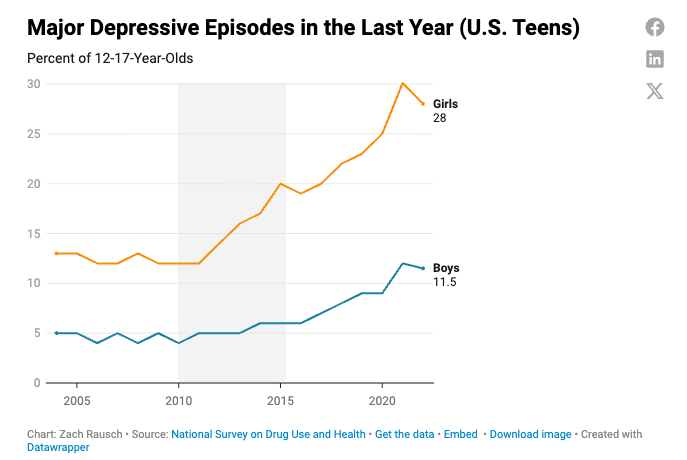
There are a lot of charts that look like this, many of them very striking. I find them compelling. But there’s no avoiding the criticism that causation isn’t well established.
Many social scientists have tried to reach more statistically satisfying conclusions by finding situations in which it is easier to isolate the phone effect. Unfortunately, among the many thousands of papers published on the subject it is possible to find just about any result you like. Some things nonetheless seem relatively clear. Smartphone use (or even just having one around) negatively affects attention and focus, in a way that seems likely to impair cognitive capabilities. And at least some segments of society experience reductions in well-being which are attributable to smartphone use.
So what? That’s not great, but it’s the kind of thing that might make you more vigilant as a parent, rather than an indication that we’ve got a doomsday device on our hands. Against this, meanwhile, we have to weigh the enormous benefits smartphones provide. All the wondrous things described at the beginning of this note are very real and highly valued by many people. As quickly as the hedonic treadmill spins, I still relish the ability to call up any music I can think of at any time. Beyond that, phones have unlocked all sorts of market opportunities. A lot of that unlocking happened in poorer countries, as mobile internet provided connectivity where older telecommunications technologies had not. There’s no good way to put a summary number on the benefits, but I promise you that if there were, the number would be very large, both in aggregate and on a per capita basis.
What we need to understand, however, is that the kinds of analyses mentioned above just aren’t going to capture the broader social impact of the smartphone. One way to begin to think about this is to adjust our perspective. I don’t think that scholars living a century from now will struggle to see the macrohistorical importance of the massive social change which flowed from smartphones. It fundamentally altered the experience of being a person in the world.
Again, this is something we’d love to put numbers to. Frustratingly, the data are murkier than one might expect, for many reasons. Many longer-running time-use surveys lacked a phone category until recently or still don’t have one. The American Time Use Survey (ATUS) conducted by the Bureau of Labor Statistics does not have a smartphone option, for instance, but instead offers things like “computer use for leisure” and “household and personal e-mail and messages”. Time-use surveys run into the problem that smartphones are often used while doing something else: working, watching television, driving, witnessing major milestones in your child’s life, etc. Studies comparing actual phone use collected from devices with self-reported use show that people generally understate how much they’re on their phones. Oh, and response rates for surveys have tumbled over the past two decades, probably in part because of the phones. (The response rate for the ATUS has declined by about 20 percentage points since the iPhone was introduced in 2007.)
Acknowledging all that, the numbers seem to show that overall screen time has risen, that the composition of screen time has shifted sharply toward phones, and that both trends are especially pronounced among younger people. People use their phones a lot. A YouGov survey from last year found that 57% of US adults are on their screens at least 5 hours a day, 36% are on them at least 7 hours per day, and 20% are on them at least 9 hours per day. For those aged 18 to 29, the numbers are 70%, 51%, and 31% respectively. Nine or more hours! For nearly a third of young adults!
But we don’t need numbers to tell us this! Phones are just everywhere you look. You stand on a street corner and watch cars go by, and many if not most drivers are looking at their phones. Go to a restaurant, and a striking number of people have their phones out. Visit family or friends, and at least a few people will be obsessively scrolling. Watch a sporting event on television and count the number of fans shown looking at their phone. Walk down a sidewalk, and experience the joy of navigating around people looking at their phones. We all know this; it is an utterly unavoidable aspect of life today.
And this is the crux of the issue. This is the evidence that something big and destructive is happening.
In my view, phones are bad for the people using them. A lot of people get grumpy when you suggest this. They say, first of all, that people surely understand their own choices well enough to know whether their phone use is a net positive for them or not. And they very often say: well I know everyone else is looking at crap on their phones, but I only engage in [supposedly edifying use]. These are the sorts of sentiments that get expressed by people who have a dependency problem, and I think that’s because nearly everyone has a dependency problem with their phone. This problem makes it difficult for us to recognize the fact that for most of the things we do with our phones, the phone is actually a pretty poor substitute for doing that thing a different way. Not everything! You can’t beat a phone for getting in touch with someone who is out in the world. If we are honest with ourselves, I think we have to admit that obsessively checking news and commentary on our phones at all hours of the day is a worse way to keep ourselves well-informed and emotionally balanced than sitting down with a print newspaper once a day, to take just one example.
But set aside the individual costs; that is not my focus here. Phones are awful, first and foremost, because they are chewing through the fabric of society. Smartphones are basically always with us, and they are very difficult to put down. They thus crowd out everything that isn’t on the smartphone. And that has simply massive social costs.
Maybe it sounds trite to say something like: people are cultural animals, our natural world is a social world, and whatever society we have is necessarily constructed out of our social interactions. I have the sense that people roll their eyes at this or treat it as unhelpful, despite its being absolutely correct and to the point. Our collective institutions exist and function to the extent that we behave them into existence and only to that extent. Our behavior is powerfully influenced by the social meaning around us: what we perceive to be acceptable or unacceptable to do, what actions and aspirations are appropriate to someone like us, what matters and what doesn’t. And we constantly update and calibrate our understanding of this meaning through our interactions with the world. Radical change in the nature of those interactions in effect rewrites the cultural code on which our societies operate. We should absolutely expect radical change in our institutional ecosystem and in the quality of the society that ecosystem produces to follow.
If you’d like a deep and detailed explanation of why this is so and how it works, I am very pleased to offer you one here. For a further and compelling case, I invite you to open your eyes. We don’t get to rerun history a thousand times both with and without phones in order to isolate their broad social effects. We have to recognize the limitations of any empirical analysis, given how complex society is, how changes cascade, how phones influence economic and social conditions in ways that make the full impact of their arrival harder to assess. We have to do our best to figure out what’s happening as it happens. As someone who experienced adulthood before the smartphone, it seems to me that the behavioral change that followed its mass adoption and the concurrent deterioration in the function of our critical institutions justify alarm and a response.
An aspect of the permanent problem
We are all implicated. It’s remarkable to me how very clever people — research-driven wonky sorts and respected academics and savvy businesspeople — will engage in conversations about the rottenness of the information environment around us, completely certain that only other people are driven mad by it. That’s not how the information environment works!
Furthermore, the conviction that smartphone brain is an individual skill issue rather than a systemic threat allows influential people to feel better about the things they do to accommodate this new phone-y world. But every accommodation represents time and energy not spent on the task of repairing the social fabric. It may be easier, and it is almost certainly a better career move, to chase one’s audience with podcasts and short-form video, rather than take on the onerous work of building communities of writers and readers committed to halting the idiotification of our society. What we have to realize is that reasoned discussion about good ideas will become impossible if everyone insists on following their own self-interest. We are losing our ability to exercise good collective judgment, and ultimately this will harm us all: those with clout and those without alike.
It is no good trying to wriggle out of this mess. We need to understand it, rather, as the first battle of the long war we must fight with ourselves if we want to build ever-better futures. The problem of the phone is in part a problem of abundance. It is a better problem to have than material scarcity, but it is nonetheless a serious problem, the more so because we have never had to face it before.
Right now, this problem is most acute where information is concerned. Nearly everyone can listen to nearly anything they want at nearly any time. This is a good thing. But in this world, how do we keep music alive, vibrant, challenging, and important? How do we appreciate it well and enjoy it together? We have vast amounts of information at our fingertips. How do we find ways to use this judiciously, to serve our collective ends? These are not problems that we can leave individuals to handle themselves, because what is at issue is collective meaning and purpose. We need to establish what matters to us — what has value and what is worth pursuing — when the judgments imposed by scarcity no longer structure our social world.
This is just the beginning, though. Our lives are ever less shaped by material scarcity, and progress across artificial intelligence and robotics should mean that we all find ourselves having to do ever less to produce ever more of the physical things around us. To be clear, there are still a lot of scarcities to be addressed; we need more housing, more energy, more and better medical treatments, more care for those in need of care, more room in our carbon budgets, and so on. But we also need to understand that if and as we alleviate these scarcities, we more fully confront our permanent problem: in which “more” no longer reliably raises well-being, and the pursuit of “more” cannot provide a sound basis for a good society. Instead, we need to learn to exercise self-restraint, collectively consider what we want our world to be like, and work purposefully to create it.
Information abundance is here now, and it is threatening to unravel our society now, and so this work must begin now. The bad news is that the failure to meet this challenge could have unfathomably bad consequences, including a significant and long-lasting decline in our productive capacity and in both the quality and quantity of human life. The good news is that if we do confront this challenge effectively, then the other aspects of the permanent problem could be relatively easy to manage. Well and also, the particular nature of the information challenge gives us a reasonably good picture of what an effective response might entail.
A way forward
What might it entail? For starters, I think it means that many of us need to be prepared to accept significant career and income risk as we pursue a better world. Trying to reach audiences where they are doesn’t work when the information ecosystem is dominated by powerful companies that are working tirelessly to drag them away from where we’d like them to be. The goal has to be to create a viable information ecosystem independent from the one that wants every eyeball pressed against a screen every second of the day. We could call this the supply side of the response.
There will also need to be demand-side action, and it seems clear that this necessarily involves community building. We need meetings, conferences, and events that bring people together, to talk about what’s happening and organize efforts to fight against it. Some nice things about this approach are that 1) it can be fun and energizing for the people involved, and 2) it can happen in many places, at many levels, with many different areas of focus. We can do this at the level of the neighborhood or the city, the state, the nation, or globally. We can do this within industries or interest areas. We can do it in small groups of a dozen or two, or in meetings of thousands. The aim is to build groups that draw people away from their phones, develop better norms about information consumption, support creators, and provide eager and participatory audiences for good work. We can’t expect community to just somehow appear; we have to cooperate to produce it.
Finally, to that end, we need to get busy. We need to make what we want to see in the world, not what we think will charm the algorithm or otherwise advance our commercial interests. We need to DIY this until the DIY infrastructure is as formidable as anything else around — until we are free. We can publish. We can produce great works of visual and musical and cinematic art. We can report and analyze. We can teach and research. We can exercise the editorial and critical functions that have been abandoned in the pursuit of a captive audience watching and clicking and swiping endlessly, without thought.
This is not about snobbery. The problem with our information environment isn’t that it goes out of its way to appeal to folks who are less interested in “high culture”. The problem is the crowding out of thought and meaningful interaction across all parts of society. We should all be listening to each other, writing for each other, playing music for each other, performing for each other, thinking with each other, maintaining the critical infrastructure of society with each other.
We can hope — and work to ensure — that technology continues to alleviate the scarcities around us. But we must recognize that this progress will create new and dire problems for us, and we cannot expect technology to solve those problems: not without major, ongoing, cooperative work by all of us. If we learn to manage our phones and tame the overwhelming onslaught of instantly accessible information, then we will go a long way toward solving our current social crises and the ones that loom ahead.
Further reading: In Good Faith: How the Nature of Belief Shapes the Fate of Societies